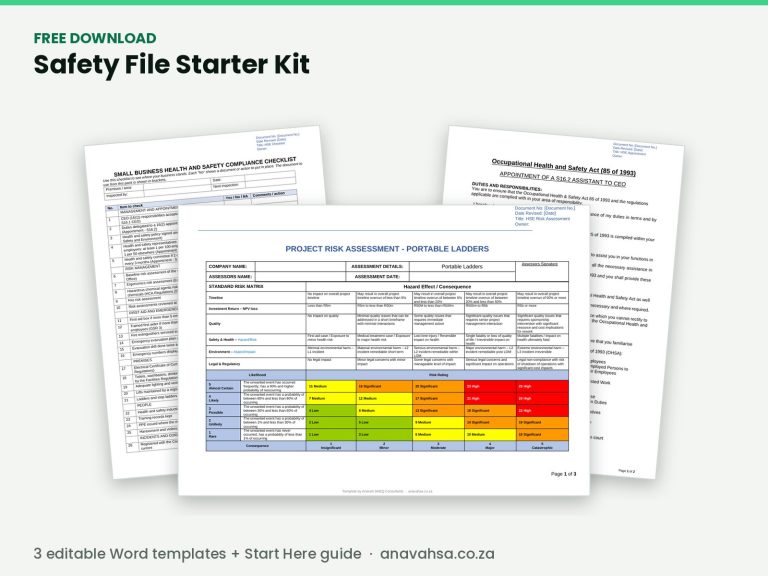
Short answer: yes. On a construction site, every contractor, including every subcontractor, must have its own health and safety plan and keep its own health and safety file on site. The main contractor’s file does not cover you, and neither does your employer’s file if you are a sub of a sub.
Here is what the law says, what your file must contain, and what changes when you work for several main contractors at once.
What the Construction Regulations say
Regulation 7(2) of the Construction Regulations, 2014 sets out the duties of every contractor. Before any construction work starts, a contractor must:
- provide and demonstrate to the principal contractor a suitable, sufficiently documented and coherent site-specific health and safety plan, and keep it updated as the work progresses; and
- open and keep on site a health and safety file, with all the documents the Act and the Regulations require, available on request.
The principal contractor, in turn, may only appoint a contractor it is reasonably satisfied is competent and properly resourced, must check that each contractor is registered and in good standing with the Compensation Fund, and must audit each contractor’s documents at least every 30 days (regulation 7(1)(c)).
If you appoint your own subcontractors, regulation 7(3) puts you in the principal contractor’s shoes towards them: you must check their competence, plan and file in the same way.
What counts as construction work?
It is wider than people think. The Regulations cover building, alteration, renovation, repair and demolition of buildings and similar structures, as well as civil works such as roads, trenches and pipelines, and installing or maintaining fixed plant where someone could fall. Electricians, plumbers, painters, roofers, aircon installers and shopfitters on a building project are all doing construction work.
What goes into a subcontractor’s safety file
- A site-specific health and safety plan that answers the client’s health and safety specification
- Risk assessments and method statements for your tasks on that site
- A fall protection plan if anyone works at height
- Legal appointments, completed and signed, such as your 16(2) appointment, construction supervisor, first aider and risk assessor
- Your COID letter of good standing
- Medical certificates of fitness (Annexure 3) and training certificates for your workers
- Induction records, toolbox talk attendance and inspection registers for tools, ladders, PPE and equipment
- Your signed section 37(2) agreement with the principal contractor
Our construction safety file checklist lists every document in order.
Working on several sites at once
Your company documents (policies, appointments, COID letter, training and medical certificates) can be reused on every site, as long as they are current. What must change for each site is the health and safety plan and the risk assessments, because the hazards, the client’s specification and the people on site are different. Many contractors keep one master file and add a site-specific section for each new job.
How Anavah can help
- Gate-ready contractor safety file in 48 hours (R3,500), fixed free within 1 business day if the main contractor sends it back
- Contractor Plan (R795 a month): a new-site pack every month, plus reminders before your certificates expire
- Trade safety file templates from R849 if you prefer to do it yourself
Frequently asked questions
I’m a one-man business. Do I still need a safety file?
On a construction site, yes. The Regulations apply to every contractor regardless of size, and the principal contractor will ask for it before you start.
Can I work under the main contractor’s safety file?
No. The principal contractor keeps a consolidated file for the project, but each contractor must provide its own plan and keep its own file on site.
My subcontractor has no safety file. Is that my problem?
Yes. If you appoint a subcontractor, you take on the principal contractor’s duties towards them, so you must make sure they have a plan, a file and a valid COID letter before they start.