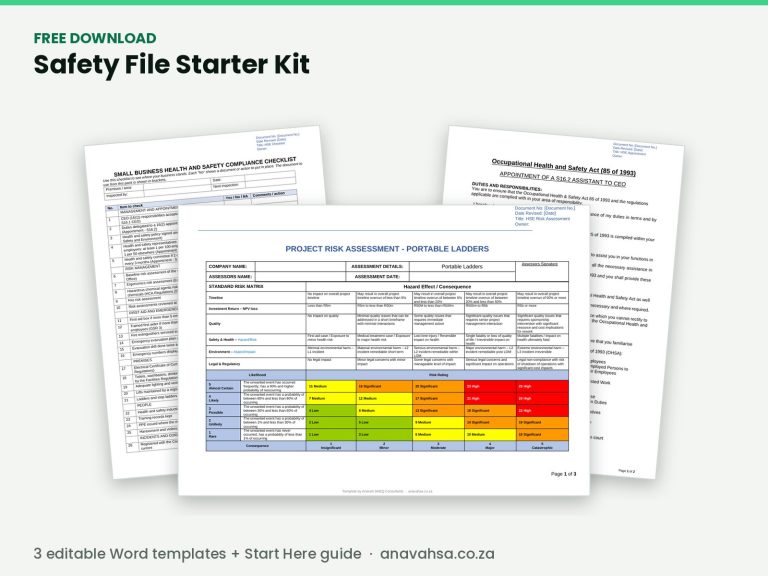
Before you’re allowed on most construction sites in South Africa, the principal contractor or client will ask for your health and safety file. If it’s incomplete, you wait outside the gate, and every day you wait costs you money. This checklist covers what a contractor’s construction safety file should contain under the OHS Act and the Construction Regulations 2014, and why each item is there.
Why a construction safety file is required
Regulation 7 of the Construction Regulations 2014 requires both the principal contractor and every contractor to open and keep a health and safety file on site, available to an inspector, the client, the client’s agent or the principal contractor. On completion, the principal contractor hands a consolidated file over to the client.
Before appointing you, the principal contractor must also be reasonably satisfied that you have the competence and resources to work safely, and that you’re registered and in good standing with the Compensation Fund. Your file is how you prove that.
The construction safety file checklist
1. Company and project information
- File index and document control
- Company details, registration and contact numbers
- Scope of work and project details
- Site organogram showing who is responsible for what
2. Legal and contractual documents
- Valid COID letter of good standing (or a licensed insurer’s certificate, such as FEM)
- Signed Section 37(2) mandatary agreement
- Your written appointment by the principal contractor
- Notification of construction work (Annexure 2) or construction work permit, where your role requires it
3. Policy and plan
- Health and safety policy signed by the CEO
- Site-specific health and safety plan based on the client’s specification (regulation 7)
- Emergency plan, site emergency contacts and evacuation procedure
4. Legal appointments
- Section 16(1) CEO acceptance and Section 16(2) appointment
- Construction manager and construction supervisor (regulation 8)
- Risk assessor (regulation 9)
- Fall protection plan developer, where work at height is done (regulation 10)
- Task-specific supervisors and inspectors for your work, for example scaffolding, excavations, ladders, portable electrical tools, hazardous chemicals
- First aider, fire fighter, incident investigator and H&S representative, where required
- Copies of competency certificates for each appointee
5. Risk assessments and method statements
- Baseline risk assessment for the scope of work
- Task-specific risk assessments and safe work method statements for every activity you’ll perform
- Fall protection plan, where there is a risk of falling
- Proof that the risk assessments were explained to the workers (signed attendance)
6. People: training, induction and fitness
- Employee list with ID numbers
- Site induction records for every worker and visitor
- Training and competency certificates, such as working at heights, first aid, plant operation
- Medical certificates of fitness for construction work
- PPE issue register
7. Inspections and registers
- Inspection registers for tools, portable electrical equipment, ladders, scaffolding, plant and vehicles
- Fire equipment and first aid box inspections
- Hazardous chemical register and safety data sheets
- Permits to work, for example hot work, confined space, excavation, working at height
- Toolbox talk attendance registers
8. Incidents and corrective action
- Incident reporting and investigation procedure
- Incident register and investigation reports
- Non-conformance and corrective action records
Keep it alive, not just complete
A file that was perfect on day one but hasn’t been updated since is one of the most common findings on site audits. Registers must be filled in as work happens: daily, weekly or monthly as required. When the scope changes, new risk assessments and method statements are needed, and when people leave, their appointments must be replaced.
Common reasons files get rejected
- Expired COID letter or missing competency certificates
- Generic risk assessments that don’t match the actual work
- Appointment letters not signed by both parties
- No fall protection plan for work at height
- Medical certificates missing for some workers
- Documents still showing another company’s name, which happens with copied templates
Skip the late nights building a file from scratch. Our Construction Health & Safety System has 477 editable documents: appointments, H&S plan, fall protection plan, risk assessments and method statements for common site jobs, permits, registers and toolbox talks. Smaller trades can use a Contractor Safety File made for their trade.
Frequently asked questions
What is a safety file in construction?
It is the collection of documents a contractor must keep on site under the Construction Regulations 2014 to show it complies with the OHS Act. It includes appointments, the health and safety plan, risk assessments, training records, inspection registers and incident records.
Who must keep a construction health and safety file?
The principal contractor and every contractor on site. The principal contractor also hands a consolidated file to the client when the project is finished.
Can I use the same safety file for every site?
Your company documents (policy, appointments, training records) can be reused, but the health and safety plan, risk assessments and method statements must be specific to each site and scope of work.
Does a small contractor need a full safety file?
Yes. The requirement applies regardless of company size, although a smaller scope means fewer task-specific documents.
What is the difference between a safety plan and a safety file?
The health and safety plan describes how you’ll manage the risks on a specific project. The safety file is the full collection of documents, including the plan, that proves you’re doing it.
We build a site-specific, gate-ready file in 48 hours. Sent back? Fixed free within 1 business day. Working on several sites? The Contractor Plan includes a new-site pack every month.
Get my file in 48 hoursSee the Contractor Plan →