“How much is a safety file?” is usually asked the day a main contractor says you can’t start on site without one. The honest answer is: anything from a few hundred rand to a few thousand, depending on who builds it, how specific it is to your site, and whether anyone keeps it up to date afterwards.
This guide sets out the real price ranges in South Africa in 2026, what you are paying for at each level, and the costs people forget.
Safety file prices in South Africa at a glance
| Option | Typical price | What you get |
|---|---|---|
| Online file generator | About R500 per file | A file generated from a questionnaire in minutes. You check and complete it yourself. |
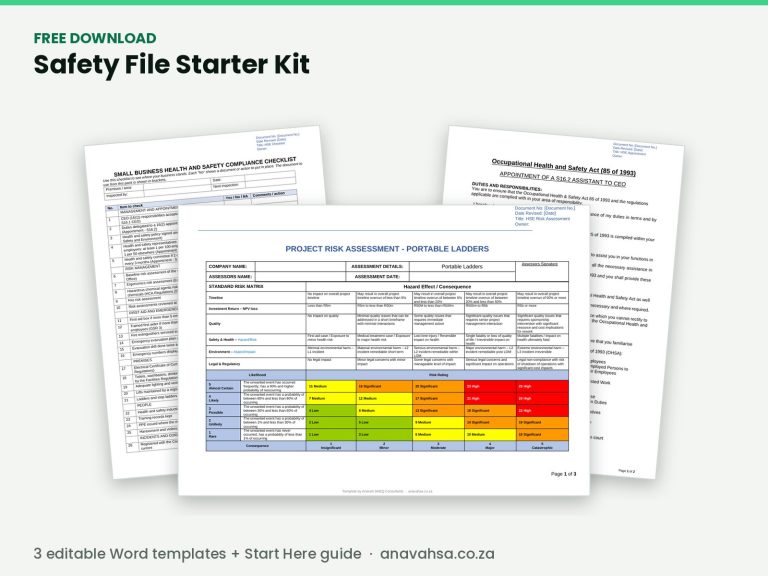
| Downloadable trade templates | About R850 to R1,500 | Editable Word templates for your trade. You add your details, site and risk assessments. |
| File compiled by a safety consultant | About R2,500 to R3,500 per file | A site-specific file prepared for you, ready to sign. |
| Monthly support plan | Anavah: R249 or R795 a month | Reminders, updates and help keeping the file current, sometimes with new-site packs. |
| Full monthly retainer | Anavah: from R1,500 a month | An outsourced safety department: the whole file built and maintained, inspections and audits supported. |
Generator and consultant prices are as advertised by South African providers in 2026 (for example MySafetyFile, which quotes R500 online and R2,500 to R3,500 for consultants). Monthly plan and retainer prices are Anavah’s own; other providers price these differently.
What decides the price
1. How site-specific it is
The Construction Regulations, 2014 require every contractor to give the principal contractor a documented health and safety plan before starting work, and to keep a health and safety file on site (regulation 7(2)). A file that only has your company name on generic documents is the cheapest, and also the one most often sent back. Risk assessments and method statements written for the actual site and tasks take more time, and that is where most of the cost sits.
2. The work you do
A painter working from the ground needs fewer documents than a roofer or electrician working at height. Work at height needs a fall protection plan, excavations need their own controls, and hazardous chemicals need safety data sheets and a register. More activities means more pages.
3. The main contractor’s requirements
Many principal contractors issue their own health and safety specification and checklist. Some ask for weekly and monthly registers and score your file at regular audits. A file built to their list costs a little more than a generic one, but it gets you on site.
4. Whether it is kept up to date
The principal contractor must audit your file at least every 30 days (regulation 7(1)(c)(vii)). Certificates expire, people leave, and each new site needs a new plan. A file that was right in March can fail in June.
Costs people forget
- Medical certificates of fitness: every worker on a construction site needs one in the form of Annexure 3 (regulation 7(8)). These are done by an occupational health practitioner and are paid for separately.
- Training: first aid, fire fighting, working at height and SHE representative courses are separate costs.
- COID letter of good standing: free from the Compensation Fund, but you must be registered and up to date with your returns and assessments.
- Your own time: if you compile it yourself, count the evenings.
Which option makes sense for you?
- One small job and you know what you’re doing: trade templates are fine.
- A main contractor wants the file this week: a consultant-built, site-specific file saves time and rejections.
- Several sites a year: a monthly plan with new-site packs is usually cheaper than paying for a new file every time.
- A permanent workplace with staff, equipment and inspections: a monthly retainer covers the whole file, reminders and inspection support.
Anavah’s prices
- Trade safety file templates: R849 to R1,049, instant download
- Gate-ready contractor safety file in 48 hours: R3,500, with free fixes within 1 business day if the main contractor sends it back
- Contractor Plan: R795 a month, including a new-site pack every month
- Monthly Retainer: from R1,500 a month, priced by team size
Frequently asked questions
Is a R500 online safety file legal?
A file is not legal or illegal because of its price. What matters is whether it contains a site-specific health and safety plan, risk assessments, appointments and the other records the Construction Regulations require, and whether it is accurate for your work. Check it carefully before you sign it.
Do I need a new safety file for every site?
You can reuse your company documents, such as policies and appointments, but the health and safety plan and risk assessments must fit each site and the work you will do there.
Who pays for the subcontractor’s safety file?
The subcontractor. Main contractors expect you to arrive with your own file, and the cost is usually built into your price for the job.