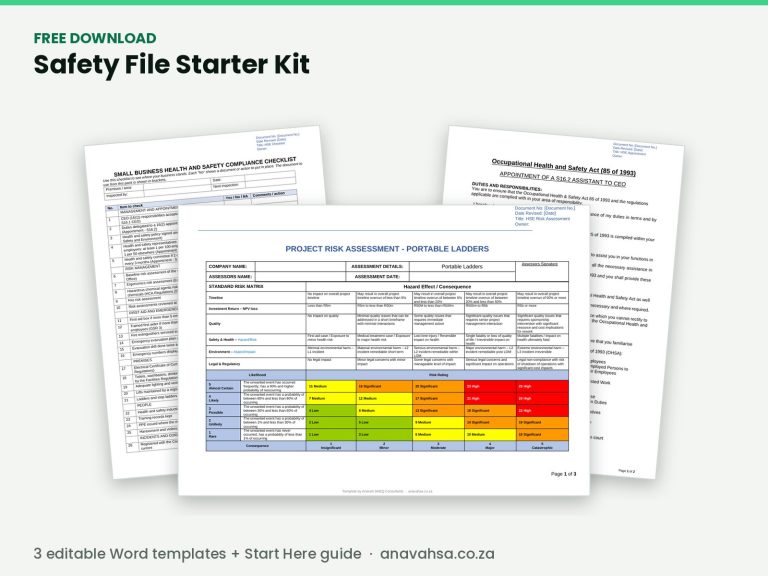
Every health and safety file starts with appointments, and the first two are Section 16(1) and Section 16(2) of the Occupational Health and Safety Act. If a client, principal contractor or inspector asks for your “16(2) appointment”, this is what they mean and how to get it right.
Section 16(1): the CEO is responsible
Section 16(1) of the OHS Act places the responsibility for making sure the employer’s duties under the Act are carried out on the chief executive officer: the person who manages the business, such as the owner, managing director or sole proprietor. In a small business this is usually the owner.
Most safety files therefore include a short 16(1) acceptance in which the CEO confirms they understand and accept this responsibility.
Section 16(2): delegating the duties
A CEO can’t personally watch every site, workshop or shift. Section 16(2) allows the CEO to assign any of these duties to another person under their control, such as an operations manager, site manager or branch manager. That person then acts under the CEO’s control and direction.
This is the 16(2) appointment. It is a written letter, signed by both the CEO and the appointee, that sets out which duties are delegated and for which part of the business.
Who should be the 16(2) appointee?
- A senior person who has real authority over the work, people and budget in that area.
- Someone who is competent and understands the OHS Act and the risks of your operation, or who will be trained.
- Someone who is actually present. Appointing a director who is never on site defeats the purpose.
Larger businesses often have more than one 16(2) appointee, for example one per branch, depot or project.
What should a 16(2) appointment letter say?
- The name and position of the CEO making the appointment and of the appointee.
- The legal reference: Section 16(2) of the Occupational Health and Safety Act 85 of 1993.
- The scope: which sites, departments or projects it covers.
- The duties assigned, for example: maintaining the health and safety file, making further legal appointments, risk assessments, incident reporting and investigation, training and induction, contractor control and inspections.
- The appointee’s authority, for example to stop unsafe work and to spend money on safety within agreed limits.
- The period of the appointment, and that it ends if the person leaves or changes position.
- Signatures and dates from both parties, with a line where the appointee accepts the appointment.
What comes after the 16(2) appointment?
The 16(2) appointee usually makes the next level of appointments that the regulations require for your type of business. Common examples:
| Appointment | Legal reference | Typical in |
|---|---|---|
| Health and safety representative | OHS Act s17 | Workplaces with more than 20 employees |
| First aider | General Safety Regulations 3 | Workplaces with more than 10 employees |
| Fire fighter / fire marshal | Emergency planning and the fire risk assessment | Most workplaces |
| Incident investigator | General Administrative Regulations 9 | Most workplaces |
| Construction manager / supervisor | Construction Regulations 2014, reg 8 | Construction work |
| Risk assessor | Construction Regulations 2014, reg 9 | Construction work |
Our free Safety File Guide shows where appointments fit into the rest of the file.
Common mistakes
- The appointment is signed by the appointee only, or by nobody.
- The person has left the company, but the letter is still in the file.
- The duties section is blank or copied from another business.
- The appointee doesn’t know they were appointed, which inspectors pick up quickly when they ask questions.
Get the appointment letters ready-made. Our Office & Small Business Safety File includes 18 legal appointments (16(1), 16(2), H&S reps, first aiders, fire marshals and more), and every Contractor Safety File includes the appointments clients ask for.
Frequently asked questions
What is a 16(2) appointment?
It is a written appointment in which the CEO assigns some or all of their health and safety duties under the OHS Act to another person under their control, in terms of Section 16(2) of the Act.
Does a sole proprietor need a 16(2) appointment?
If you are the only person managing the business, you are the 16(1) CEO and may not need to delegate. If you have a manager or supervisor running sites or shifts in your absence, appointing them under 16(2) is good practice, and clients often ask for it.
Can there be more than one 16(2) appointee?
Yes. Many businesses appoint one per site, branch or project, each with a clearly defined scope.
Does the CEO stay responsible after delegating?
Yes. Section 16(3) says that assigning duties doesn’t relieve the CEO of responsibility, so the CEO must still oversee and support the appointee.
How often should appointments be updated?
Whenever the person, their position or the scope changes. Many businesses also review all appointments once a year.