Organising a fun run, a weekend market, a school fête or a music festival in South Africa? Then you have legal duties for the safety of everyone who attends, and the municipality, SAPS and your insurer will ask what you have done about them. This guide sets out the laws and standards that apply to events, what they require in plain language, and links to the official text so you can check them yourself.
1. Safety at Sports and Recreational Events Act 2 of 2010 (SASREA)
SASREA is the main law for event safety. It defines an “event” broadly: sporting, entertainment, recreational, religious, cultural, exhibitional, organisational and similar activities held at a stadium, a venue or along a route. A “stadium” or “venue” is one certified for 2,000 or more people. A route (the course of a race or procession) has no size limit, so road races, fun runs, cycle races and processions fall under the Act.
- Section 4: responsibility for safety. The event organiser, controlling body and venue owner must put the prescribed safety measures in place. They must appoint an event safety officer, security officers and stewards, and those people must be present at the event. Stewards and volunteers may not provide security services unless they are registered security officers. An organiser who is a natural person must be at least 21.
- Low-risk events (section 4(9) and (10)). The organiser must appoint a safety officer, prepare a written safety plan, put the measures in place and inform the local police station beforehand. The plan must cover the risk assessment, event details, venue or route design and safe capacity, spectator profile, service providers, facilities, liquor control, fire, emergency medical measures, access and egress, safety announcements and evacuation.
- Section 6: risk categorisation. SAPS (the National Commissioner) categorises events as low, medium or high risk. Organisers must submit an annual schedule of events at least six months before the year or season; unplanned events must be submitted as soon as planning starts.
- High-risk events need a high-risk event safety certificate, applied for at least 60 days before the event. Stadiums and venues need safety certificates from the local authority.
- Hosting an event without the required public liability insurance, without the required appointments or without a required certificate are offences.
Official text: SASREA on gov.za · Section 4 (Acts Online) · Section 6 (Acts Online) · Definitions (Acts Online)
2. Safety at Sports and Recreational Events Regulations, 2017
Published as GN R200 in Government Gazette 40661 of 3 March 2017. They deal mainly with stadiums and venues: safety and grading certificates, operational requirements (safety corridors, evacuation, medical rooms, fire equipment, signage, emergency vehicle access) and the application forms. One rule that catches event organisers: an application must be made at least 14 days before a temporary structure is erected at an existing stadium or venue.
Official text: SASREA Regulations, 2017 (PDF, gov.za)
3. Occupational Health and Safety Act 85 of 1993 and its regulations
The OHS Act applies to every event, whatever its size. Section 8 covers your duties to your employees, section 9 your duty to make sure your activities don’t endanger anyone else (runners, visitors, stallholders, volunteers), section 24 the reporting of serious incidents, and section 37(2) written agreements with contractors. The General Safety Regulations (first aid) and the Construction Regulations 2014 (building and taking down stages, marquees, grandstands and rigging) also apply.
Official text: OHS Act on gov.za · Construction Regulations 2014 on gov.za · Our guide to Section 37(2) agreements
4. SANS 10366: Health and safety at events
The South African National Standard for event safety. It covers event safety planning, medical cover, crowd management and temporary structures (chapter 14). It is not a law on its own, but municipalities, SAPS and insurers use it to judge whether your plans are adequate. SANS standards are copyright documents: buy the current edition from the SABS.
5. Municipal events, trading and noise by-laws
Most municipalities require an event permit, and often a safety plan, medical plan, traffic plan, fire department approval and proof of insurance. Markets may also need a trading permit and landowner consent, and amplified music must stay within noise limits and curfews. Requirements and lead times differ between municipalities, so ask your local events office early (30 to 90 days before is common).
6. Roads, traffic and race sanctioning
Using or closing public roads for a race needs written permission from the road authority or traffic department under the National Road Traffic Regulations (regulation 317: racing and sport on public roads) and municipal by-laws. Only traffic officers or authorised points-persons may stop traffic. Running races and fun runs must also be sanctioned by the provincial athletics body (KZN Athletics in KwaZulu-Natal) under Athletics South Africa rules, usually through an affiliated club.
7. Medical cover
Ambulances and medical teams must be provided by a licensed emergency medical service. The rules for EMS providers are in the Emergency Medical Services Regulations under the National Health Act. Size your cover with your provider using SANS 10366, the number of people, the distance or duration and the expected weather.
8. Food, liquor, gas, fire and fireworks
- Food traders need a Certificate of Acceptability and must follow the hygiene rules in R638 of 2018 (PDF, Department of Health).
- Liquor may only be sold under a licence or special event permit. In KwaZulu-Natal this is the KwaZulu-Natal Liquor Licensing Act 6 of 2010 (PDF). No sales to anyone under 18.
- LP gas at food stalls must be used safely (SANS 10087-1), and fire safety is governed by the Fire Brigade Services Act 99 of 1987 and municipal fire by-laws.
- Fireworks and pyrotechnics need permits and a licensed operator under the Explosives Act 15 of 2003 and municipal by-laws.
- Temporary power must comply with the Electrical Installation Regulations (Certificate of Compliance) and generators must be earthed and placed safely.
9. Security, personal information and consumer law
- Security companies and officers must be registered with PSIRA under the Private Security Industry Regulation Act 56 of 2001 (PDF).
- Entry forms collect personal and medical information, so follow the Protection of Personal Information Act 4 of 2013 (POPIA).
- Indemnities on entry forms must be brought to the entrant’s attention in plain language under the Consumer Protection Act 68 of 2008, and they cannot exclude liability for gross negligence.
Quick checklist: what most events need
| Document or approval | Fun run | Market / community day | Festival / concert |
|---|---|---|---|
| Event safety officer appointed in writing | Yes | Yes (required under SASREA for 2,000+ venues) | Yes |
| Written event safety plan with risk assessment | Yes | Yes | Yes |
| SAPS informed in writing | Yes | Yes (recommended for all) | Yes; risk categorisation |
| Municipal event permit | Usually | Usually | Yes |
| Road use / closure approval | Yes | If roads are used | If roads are used |
| Athletics sanction | Yes | No | No |
| Medical cover (licensed EMS) | Yes | First aid; EMS for larger events | Yes |
| Public liability insurance | Yes | Yes | Yes |
| Food traders’ COAs; gas and fire checks | If food is sold | Yes | Yes |
| Liquor licence / special event permit | If liquor is sold | If liquor is sold | If liquor is sold |
| Structural sign-off for stages and grandstands | Rarely | Rarely | Yes |
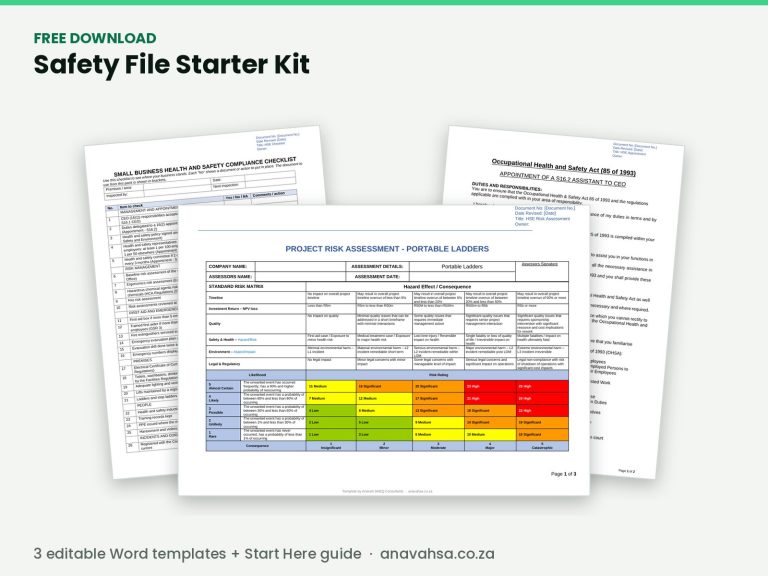
Need the paperwork? Our editable event safety files include the safety plan (following SASREA section 4(10)), risk assessments, appointment letters, SAPS and municipal letters, checklists and registers: the Fun Run & Community Race pack, the Markets & Community Events pack and the Complete Event Safety File for festivals, concerts and sports days. Prefer someone on the ground? We can act as your event safety officer on the North Coast.
Frequently asked questions
Does SASREA apply to a small fun run?
Yes. SASREA covers events held along a route, such as races and processions, and the route definition has no minimum number of people. The organiser must appoint a safety officer, prepare a written safety plan and inform the local police station. Most fun runs are categorised as low risk.
Does a weekend market need a safety plan?
SASREA’s venue rules apply from a certified capacity of 2,000 people. Smaller markets still have duties under section 9 of the OHS Act and municipal by-laws, and most municipalities and insurers expect a written safety plan, risk assessment and emergency procedure, especially where food stalls use gas.
Who categorises an event as low, medium or high risk?
SAPS (the National Commissioner) categorises events under section 6 of SASREA, based on factors such as expected attendance, the venue or route, liquor sales, timing, past incidents and available emergency services. Ask your local police station how to apply.
Can volunteers act as security at my event?
No. Under SASREA, stewards and volunteers may not provide security services unless they are registered as security officers with PSIRA. Volunteers can marshal, guide people and help in emergencies.
Is SANS 10366 compulsory?
It is a national standard rather than a law, but authorities and insurers use it as the benchmark for event safety. Following it is the easiest way to show your plans are adequate.